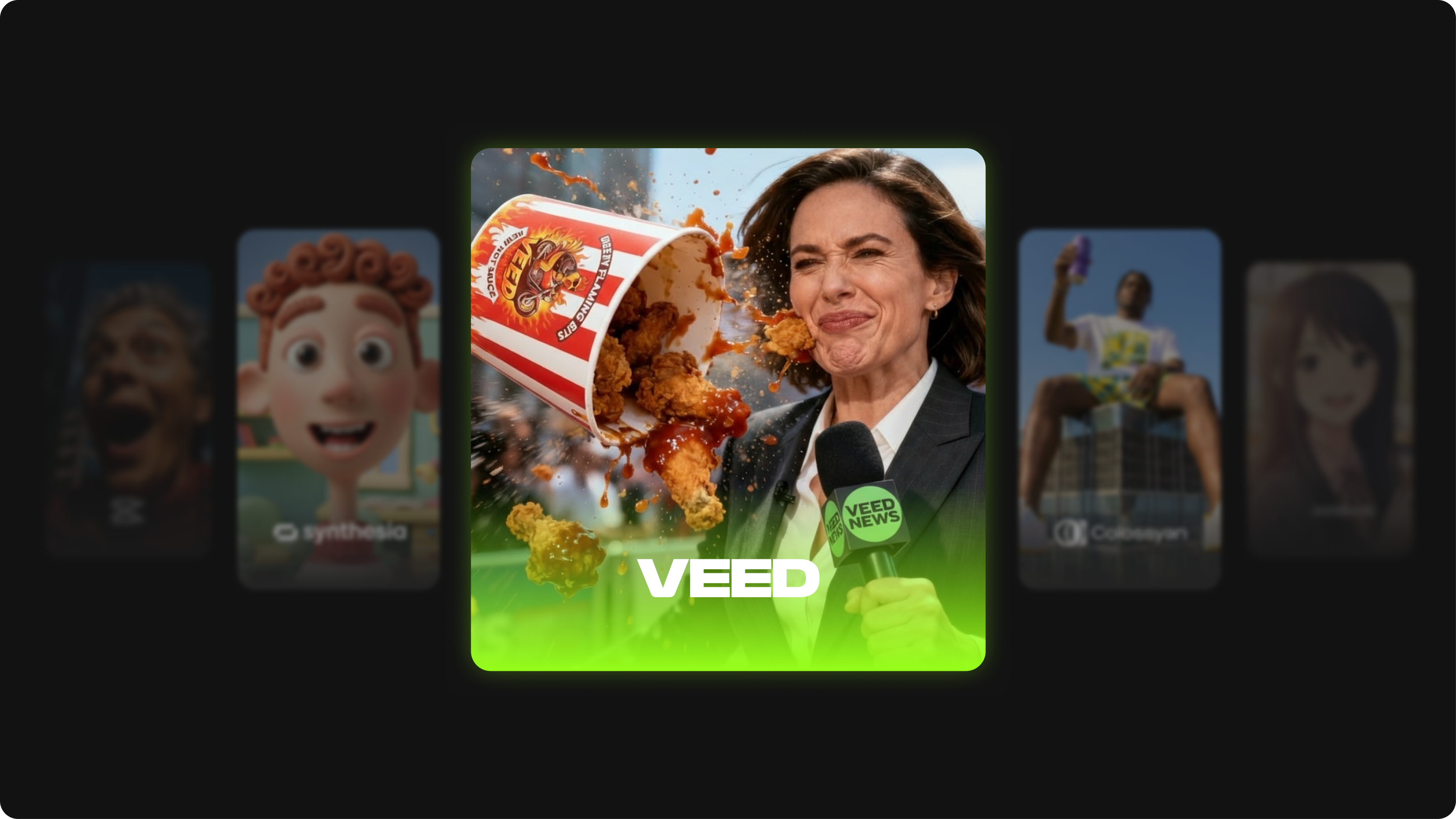
You’re possibly here because you saw someone post a carousel of stunning, surreal images — art made by AI that felt anything but artificial. Maybe they captioned it with something like “Prompt: a dreamscape stitched from velvet clouds and neon koi.” And maybe you thought: Wait. That’s all it takes? Just a few words?
Then you tried it. You typed in “castle on a mountain at sunset,” hit generate, and got...something beige. It wasn’t bad. It just wasn’t that.
If you’ve ever wondered why some people’s AI art looks like a Dali-Pixar crossover while yours feels more like a stock photo with a filter on it, this guide is for you.
We’re going to unpack the craft of AI prompting: how to write prompts that actually spark something new, the kind of prompts that give your image soul. We'll dig into real examples, not just “castle at sunset,” but “a castle made of light, breaking through storm clouds in a Turner-style sky.”
You’ll also find the best tools to bring your vision to life, including VEED’s own AI Image Generator, which takes your prompt and plugs it into your workflow without skipping a beat.
.png)
How to write better AI art prompts
Let’s start with a small truth that most people skip over when using AI image generators: the prompt isn’t a command. It’s a collaboration.
Your words are the DNA. They decide whether you get something vivid, strange, and powerful, or something safe, vague, and a little boring.
Think of it like this. If your brain is the director, the prompt is your storyboard. You don’t have to micromanage every element, but you do need to give the AI a strong vision. One that carries intent, emotion, and texture.
Whether you’re a marketer trying to create a scroll-stopping visual or a content creator building moodboards for a video, here’s how to write prompts that do the heavy lifting.
Start with your intention
Most people start with what they want to see. But great prompts often begin with how they want the image to feel.
Do you want it to feel cinematic? Intimate? Tense? Dreamy? That choice changes everything, from the composition to the lighting to the color palette the AI picks.
For example: “a man standing in an empty subway station” vs. “a solitary man waiting in a shadowy, flickering subway station, soaked in blue light, 1980s thriller atmosphere.” The difference is mood. And that comes from intent.
Use rich, visual language
Specificity helps. Instead of just naming objects, describe how they live in the scene. Use adjectives that carry color, texture, and era. Replace “house in the woods” with “a crooked wooden cabin nestled in frost-covered pines, smoke rising into a grey winter sky.” But don’t overload it. Give the AI room to interpret and surprise you.
Include style, medium, and lighting if needed
Is it a digital painting or a film still? Shot on a 35mm lens or illustrated with watercolor? Saying so can shift the entire aesthetic.
Try phrases like:
- “in the style of a retro sci-fi movie poster”
- “hyper-realistic studio photography”
- “vaporwave color palette”
- “pencil sketch with crosshatching details”
These clues help shape not just the content but the execution.
Experiment with unexpected combinations
One of the most exciting things about working with AI-generated art is that it’s not bound by the laws of physics, logic, or even realism. In fact, the more you stretch those boundaries, the more creative and original your results become.
AI thrives in the in-between. The strange pairings. The ideas that sound absurd on paper but come alive when visualized. That’s where things get interesting.
Instead of defaulting to something straightforward like “a cathedral in the mountains,” try “a cathedral carved from coral reef, glowing under moonlight at the bottom of the ocean.”
Or “a medieval knight in a spacesuit riding a flamingo through a cyberpunk carnival.” These odd mashups challenge the AI model to find visual connections between wildly different concepts and that’s where the magic happens.
Don’t forget the framing
Want something close-up? Say that. Want a dramatic landscape with everything in view? Add “wide-angle view” or “aerial perspective.” Framing changes how your image tells a story.
Try: “macro shot of a mechanical butterfly perched on a glowing circuit board” vs. “a wide shot of a neon jungle where mechanical butterflies swarm under a glowing sky”. Same core element, completely different results.
Try storytelling prompts
The most striking AI art doesn’t just show you something, it pulls you into a scene mid-beat. That’s the difference between a static prompt and a storytelling one. Instead of describing an object or setting, you describe a moment unfolding.
Think of it like this: “a woman at a table” gives you a scene. But “a woman alone on a rooftop, fireworks blooming behind her, fingers circling her wine glass as she waits” gives you a feeling. There’s tension, motion, and mood, even though nothing dramatic is happening. That’s the power of story.
To write prompts like this, imagine what just happened or what’s about to happen. Focus on small details that hint at emotion: a hand gesture, the lighting, the weather. These clues help the AI build something more cinematic, less like a still life, more like a paused film.
Try:
- “An astronaut reaching for a drifting tether.”
- “A dancer mid-leap on a rain-slick rooftop.”
- “A boy crouched by a glowing vending machine, flashlight in hand, fog curling at his feet.”
Prompt categories to spark your imagination
Sometimes, the hardest part is just knowing what to create. You open the AI image generator, fingers hovering over the keyboard… and then the blank space just stares back.
That’s where prompt categories come in. Not as templates, but as starting points. Think of them as creative buckets that help you get unstuck and start thinking visually again. These aren’t broad or boring. They’re designed to push your imagination, spark ideas, and open up new directions, whether you’re experimenting with concept art or creating visuals for a real project.
Here are seven types of prompts that can help you break creative blocks and make better images faster.
Cinematic worlds

Think of this as your director’s chair. Cinematic prompts are all about mood, story, and framing, creating images that feel like a scene pulled from a movie. These work especially well for ad storyboards, video concepts, or social content with a narrative angle.
What sets them apart is the way they use lighting, camera angles, and subtle details to imply action or emotion. A quiet diner lit by neon. A character framed in silhouette before something major happens.
If it feels like it could be part of a film poster or an opening shot, you’re on the right track.
Prompts to try:
- A wide-angle shot of a futuristic commuter terminal carved into a coastal cliffside, glowing with amber morning light. Travelers in metallic jackets walk beneath arched skylights streaked with condensation, while silent levitating trains arrive on illuminated tracks. The mood suggests a calm before the storm in a sci-fi thriller.
- An overhead shot of a midnight diner in the rain, neon lights flickering outside. A lone woman sits at the counter stirring her coffee, duffel bag at her feet. Reflections ripple across the wet tile floor. The scene feels heavy with waiting like the beginning of a story you can’t quite place.
Surreal dreamscapes

This is where the rules go out the window. Surreal prompts help you move beyond realism and into imagination, perfect for unlocking unusual ideas or breaking out of creative ruts.
Start with something familiar, then distort it: a city made of clouds, a river flowing upward, a staircase leading into a moonlit sky. These combinations don’t need to make sense. That’s the point. The weirder the twist, the more original the outcome.
These prompts are especially useful when you want to tap into visual metaphor or symbolism; think album art, abstract covers, or anything that needs to feel dreamlike and open-ended.
Prompts to try:
- A gothic cathedral floats upside-down in a lavender sky, its stained-glass windows casting fractured light onto drifting clouds. Invisible walkways connect people across the sky, their shadows trailing like ribbon streams behind them. Everything glows faintly, like a lucid dream halfway fading.
- A staircase made of jellyfish domes spirals into an ocean suspended midair. Fish swim through sunbeams that cut across the scene, while a cloaked figure climbs slowly, dragging a suitcase full of marbles. The moment feels frozen in time, soft and surreal.
Conceptual portraits

Portraits don’t always need to be literal. In this category, you’re using metaphor to say something about the person, not just what they look like, but who they are or what they represent.
It could be a woman made of pages from a book, her body gently unfolding in the breeze. Or a musician with a piano built into their silhouette, keys glowing in rhythm with their heartbeat. These prompts work well for creators, authors, and artists who want visuals that reflect their deeper story.
A good conceptual portrait feels symbolic, layered, and personal. It turns identity into something visual.
Prompts to try:
- A woman composed of interwoven film strips, her face calm, her dress flowing like running water. Behind her, projections of old memories flicker against a wall. One reel lifts from her shoulder mid-spin, capturing the quiet ache of remembering.
- A man sits in a dark gallery, circuitry glowing faintly beneath cracked skin. His tailored suit is stitched with binary code. Floating around him: glowing memory orbs, each reflecting a different version of himself. The image balances nostalgia and modernity.
Futuristic architecture

These prompts help you imagine the built environment of tomorrow, perfect for world-building, speculative design, or high-concept campaigns.
But don’t just describe a building. Think about how it works. What materials power it? Who lives there? What problems does it solve?
Try a vertical city suspended between cliffs, powered by wind and algae. Or a floating village shaped like lotus flowers, glowing gently above a coral reef. When you combine design thinking with visual storytelling, you end up with images that feel not just futuristic, but possible.
Prompts to try:
- A vertical eco-city suspended between two cliffs, wrapped in spiraling algae farms and wind turbines. Transparent biodomes line every floor, connected by skybridges turned marketplaces.
- A modular floating city drifts across a moonlit ocean. Each building resembles a glass petal, opening to reveal soft gardens. Walkways are lit by bioluminescent algae, and aerial taxis pass silently overhead.
Emotional moments

Some images don’t need to be loud to be powerful. Emotional prompts capture the quiet in-between moments: longing, comfort, solitude, anticipation.
Instead of stating the emotion, describe what it looks like. A child standing at an empty bus stop, holding a wilted flower. An older couple holding hands in a rainstorm, laughing under a shared umbrella. These prompts work best when they’re specific, subtle, and honest.
They're great for social campaigns, narrative visuals, or anything where you want the image to do more than just look nice, you want it to connect.
Prompts to try:
- A child sits alone on a swing at dusk, holding a half-inflated balloon. Autumn leaves scatter across the ground, and the last sunlight filters softly through the trees.
- A woman in a dim kitchen, hands wrapped around a steaming mug, staring out at falling snow through a fogged-up window. On the table beside her: an old photograph, half-tucked under a folded napkin.
Nature reimagined

Take something organic, and twist it into something otherworldly. These prompts merge the familiar and the fantastical, making forests glow, turning mountains into glass, letting rivers flow through the sky.
This category works beautifully for sci-fi, fantasy, and whimsical projects where you want your setting to feel magical but still grounded. Start with real-world textures or ecosystems, then change the laws of nature: bioluminescent trees, talking vines, floating deserts. The result is often beautiful, strange, and hard to look away from.
Prompts to try:
- A crystalline forest with glowing roots and metallic-feathered leaves. Above, twin moons orbit in a purple sky, casting glimmers across the translucent canopy.
- A mountain range sculpted from clear glass, refracting the peach tones of a sunrise. In the valleys, light rivers pulse like veins, and floating moss-covered stones drift lazily above.
Mythical creatures with a twist

Dragons, phoenixes, griffins — we’ve all seen them. But what if you made them new?
This category is all about reimagining familiar creatures through new styles, materials, or cultural references. A dragon made of stained glass. A unicorn with circuitry running through its mane. A griffin woven from silk and moss.
These prompts are great for concept artists, game designers, and fantasy creators who want to move beyond cliché and bring fresh energy into their worldbuilding.
Prompts to try:
- A dragon made of cracked porcelain, its wings delicately painted with blue floral patterns. As it flies over an autumn forest, petals fall from its tail, and golden light glows from within its fractures.
- A phoenix rising in a cathedral-like library, its feathers made of paper torn from ancient texts. As it soars, symbols glow and dissolve into floating embers.
The 3 best AI art generators to try today
Even with the most beautifully written prompt, the output ultimately comes down to the tool you're using. Some AI art generators specialize in photorealistic results, while others lean into abstract or painterly styles. Some are beginner-friendly, others reward experimentation and advanced prompt engineering. If you want consistently striking results, here are three standout AI art tools worth trying, whether you're designing for fun, for clients, or for your own brand.
VEED’s AI Image Generator
If you want something intuitive, fast, and actually built for creative workflows, VEED’s AI Image Generator is a smart place to start.
What makes it stand out? You can go from text prompt → image → video in the same platform. That’s a huge time-saver if you’re producing content for social media, marketing campaigns, or storytelling videos. It’s built with creators and teams in mind, so the interface is clean, simple, and flexible enough to test multiple prompt styles in one go.
You don’t need any design background to get great results, and the image quality is crisp enough for pro use cases. If you're someone who regularly turns ideas into content, the fact that VEED connects image generation to video editing makes it more than just a one-off novelty, it becomes part of your workflow.
✅ Great for: marketers, video creators, fast-moving content teams
🎨 Best for: prompt testing, branded visuals, creative consistency
💡 Try it here: veed.io/tools/ai-image-generator
Midjourney
Midjourney is for the explorers. It lives inside Discord and gives you an unusual mix of painterly textures and surreal detail, ideal if you want to push the visual boundaries of your prompts.
It’s not the most beginner-friendly tool, but once you get the hang of how it interprets language, it rewards you with striking, often hauntingly beautiful results. You’ll want to spend time playing with styles, weights, and advanced prompt structures to really unlock its potential.
✅ Great for: artists, designers, creative directors
🎨 Best for: surreal scenes, concept art, moody visuals
💡 Access via: Discord (midjourney.com)
DALL·E 3 (via ChatGPT or Bing)
If you’re looking for something accessible and conversational, DALL·E 3, especially when accessed through ChatGPT, makes the process incredibly smooth.
You can describe what you want in plain language, and ChatGPT will help shape the prompt for you. This is ideal for quick idea generation, content mockups, or visual brainstorming. The outputs tend to be clean, literal, and fast, so if you’re in a rush or just need something to sketch an idea, it’s a solid go-to.
✅ Great for: casual creators, writers, educators, small businesses
🎨 Best for: simple scenes, brand illustrations, fast drafts
💡 Access via: ChatGPT Pro or Bing Image Creator
Final thoughts: treat your prompts like seeds
Here’s the real takeaway: writing great AI art prompts isn’t about being poetic or using perfect grammar. It’s about giving the AI model clear direction like a visual brainstorm written out in words.
Your prompt is the blueprint. The AI is your builder. The more specific, visual, and intentional you get, whether you're describing art styles like oil painting, anime, or pop art, or experimenting with cyberpunk cityscapes, the better your AI-generated art will look.
It’s not about automating creativity. It’s about augmenting it. Whether you're using generative AI for digital art, photorealistic renders, or minimalist illustrations, the best way to improve is to explore, iterate, and test. Try changing the color scheme. Add a camera angle. Reference famous artists like Van Gogh or an impressionist palette. Use niche art movements or blend them together.
Some prompts will flop. Others will surprise you. But the only way to get better at writing image prompts is to keep experimenting. So play with it. Treat each prompt like a creative draft, not a final command.
And when you do land on something that clicks, save it. Remix it. Use it again with a new AI model like Stable Diffusion or OpenAI’s DALL·E. The more you treat prompt-writing like a practice, the more high-quality, scroll-stopping AI-generated images you’ll make.